
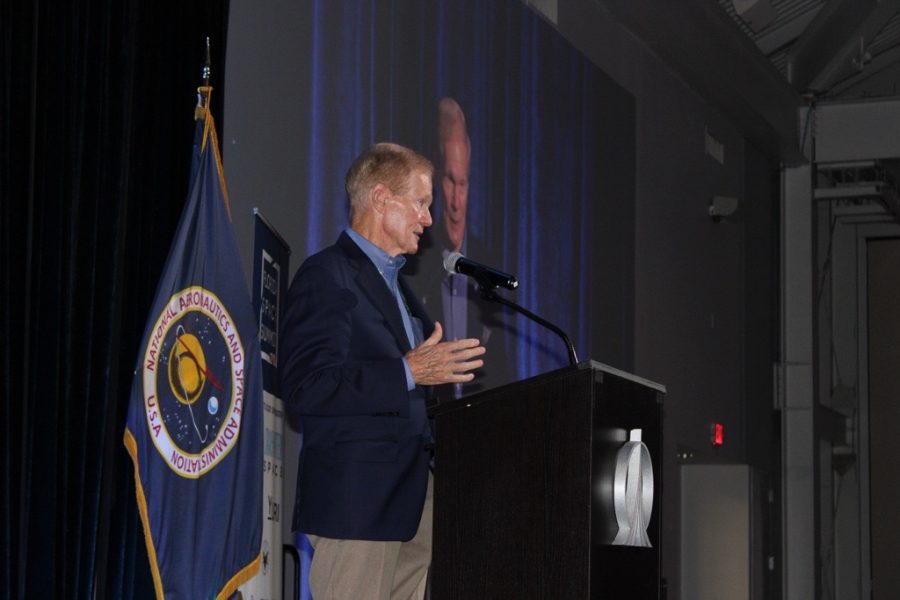
CAPE CANAVERAL, Fla. — Researchers, students, NASA leaders and industry and government partners gathered Oct. 20-21 at Kennedy Space Center for Space Education for the Florida Space Summit, highlighting Florida’s growing role in space research, technology development and economic growth.
Hosted by the University of Florida’s Astraeus Space Institute in partnership with the Florida Space Research Consortium, the two-day summit brought together participants from 11 Florida universities. The event featured more than 50 scientific presentations and 100 research posters spanning space health, agriculture, propulsion, advanced materials, artificial intelligence, planetary science, astronomy, life support, sensing and autonomy.
Participating universities included Florida Institute of Technology, the University of Florida, the University of Central Florida, the University of Miami, the University of South Florida, Embry-Riddle Aeronautical University, Florida International University, Florida A&M University, Florida Atlantic University, Florida State University and Florida Gulf Coast University.
The summit brought together academic researchers, students, government representatives and industry partners to explore opportunities for collaborative research, technology development and workforce growth. Featured participants included Dr. Lisa Carnell, director of NASA’s Biological and Physical Sciences Division; Dr. Dorit Donoviel, executive director of the Translational Research Institute for Space Health; and Brian Hughes, director of NASA’s Kennedy Space Center.
Former U.S. Sen. Bill Nelson also delivered remarks, underscoring the importance of space research and collaboration in advancing Florida’s role in the space sector.
The event emphasized the importance of expanding Florida’s space economy beyond launch and commercial operations by strengthening the research and technology development that will shape future missions. Organizers aim to build partnerships among universities, NASA, government agencies and industry to support joint research initiatives, future funding opportunities and economic development across the state.
“Florida is uniquely positioned to bring together industry, government, academia and nonprofit organizations,” said David Norton, UF’s vice president for research. “This summit strengthens those connections so we can collectively advance the state’s role as a global leader in space research, technology and exploration.”
Rachael Seidler, director of the UF Astraeus Space Institute, said the summit demonstrated the breadth of space research taking place across Florida and the opportunities to translate that work into meaningful discoveries.
“The Florida Space Summit showcases the incredible breadth of space research happening across our state and the opportunities to turn that research into meaningful discoveries,” Seidler said. “By bringing together universities, industry and government, we can build partnerships that advance space exploration and strengthen Florida’s leadership in the space economy.”
Alain Berinstain, director of the Florida Space Research Consortium, emphasized the importance of collaborative research in advancing both scientific discovery and Florida’s economic development goals.
“The launch is only the beginning of the story,” Berinstain said. “The real value lies in the payloads and the research we can launch from Florida into space. By bringing our eight universities together through the Florida Space Research Consortium, we can advance research that supports Florida’s economic development goals and achieve bigger things at both the state and federal levels than any one institution could accomplish alone.”
The summit also highlighted the importance of developing Florida’s space workforce by connecting students and early-career researchers with established scientists, employers and research partners. These connections can help students identify career opportunities in Florida and encourage highly skilled graduates to remain in the state.
While Florida is internationally recognized for its launch infrastructure and commercial space activity, the summit focused on strengthening the research enterprise behind that growth. Research in space health, agriculture, advanced materials and artificial intelligence can advance future missions while supporting technologies with applications on Earth.
By bringing together 11 universities and partners from government and industry, the Florida Space Summit reinforced the value of a coordinated statewide approach to space research. Through UF Astraeus and the Florida Space Research Consortium, participating institutions are working to expand partnerships, pursue new research opportunities and strengthen Florida’s position in the national space economy.